Meta shipped two models on October 12, 2026. The stronger one is Muse Wonder Full. You get it by subscribing to Muse Code: Power at $50 a month, or Maximum at $200. It is not sold by the token.
The model on the API is the other one. The id is muse-wonder-1.0, at $4 per million input tokens, $0.20 cached, and $20 output. That is Opus's list price. Muse Spark 1.3, six weeks earlier, was $1.25, $0.15, and $4.25.
On the Artificial Analysis Intelligence Index at max effort, the subscription model scores 56. The API model scores 52. Opus 5.5 still leads that chart at 58. Sonnet 5.5 at max is also 56. Astra is 53. GPT-6.1 Sol at max is 52, the same index as the API model.
Both take text, image, video, and audio, and return text. Context is 1 million tokens, the same window as Spark 1.3. Meta's published comparisons use max effort. On SWE-Marathon, the Full result Meta cites is xhigh, and that row is not a shared harness. Refusals stay in the denominator as zeros. The bar for Full on the index chart is marked as having no public API.
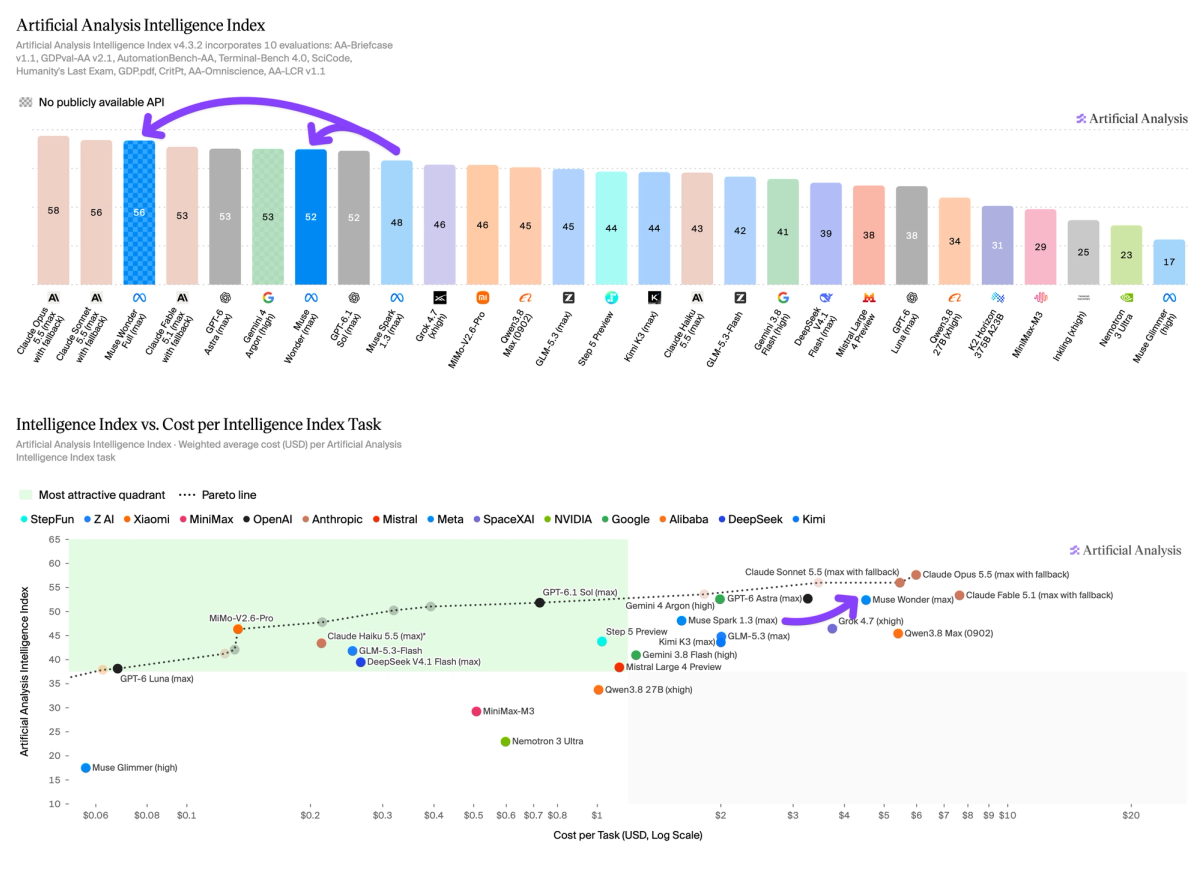
Artificial Analysis. The subscription model is 56 and has no public API. The API model is 52. On the cost chart, that API model sits to the right of Astra and well to the right of GPT-6.1 Sol.
What the subscription buys over Spark
Spark 1.3 at max was 48. Full gains 8 points, and it gains them on every one of the ten evaluations in the index. The API model gains 4.
The largest move is Terminal-Bench 4.0. Spark was 33%. The API model is 52%. Full is 57%, level with Gemini 4 Argon at high. On AutomationBench-AA, Spark was 58%, the API model is 68%, and Full is 71%.
On knowledge work, Full is the one that changes the ranking. GDPval-AA v2.1 goes from 1681 Elo to 1857, a gain of 176. That 1857 sits inside the confidence interval of Opus 5.5 at max with fallback, 1866, and of Sonnet 5.5 at max with fallback, 1838. AA-Briefcase goes from 1581 to 1729, a gain of 148. Full is third there, and third on AutomationBench.
It is first on two narrow boards, by a small margin. CritPt is 33%, with the next models at 31% to 32%. GDP.pdf is 33%, the same kind of lead. SciCode is 63%, third. Those are Artificial Analysis's runs. Meta also publishes a GDP.pdf figure from Surge. Keep that in Meta's column. It is a different measurement from this 33%.
The API model sends most of the bill to input
Both models use about 54,000 output tokens per index task, about 10% fewer than Spark's 60,000. That is less than Gemini 4 Argon at high, about 62,000, and less than Fable 5.1 at max with fallback, about 78,000. It is more than GPT-6.1 Sol at max, about 38,000, and more than Astra at max, about 27,000.
Full is the more economical of the two on input: 6.44 million input tokens per task, against 7.69 million for the API model, about 16% less. The API model's 7.69 million is 28% more input than Spark used. Output got a little shorter. Input, on the model you can call, got longer, at a much higher token price.
One index task on the API model costs $4.52. That is 2.8 times Spark's $1.60. Input and cache are $3.43 of it, 76%: $1.92 of cache writes, $1.44 of cache hits, and $0.07 of uncached input. The output is about $1.08. Full has no per-token price, so Artificial Analysis does not publish a task cost for the subscription model.
That $4.52 is above Astra's $3.26, and Astra scores a point higher. It is far above GPT-6.1 Sol's $0.72 at the same index of 52. It is below Sonnet at max with fallback, $5.46, Opus at max with fallback, $5.98, and Fable 5.1 at max with fallback, $7.63.
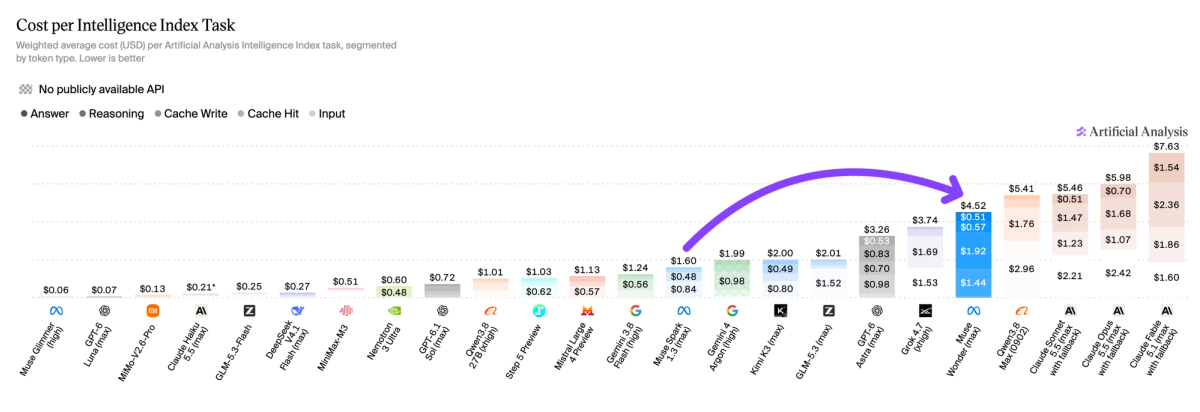
Artificial Analysis. The API model is $4.52 a task. The blue segments are cache writes and cache hits. The subscription model is absent, because it has no token price.
Knowledge is still the weak board
On AA-Omniscience, Full scores 30 and the API model scores 25, level with Spark 1.3 at max. Opus is 46. Astra is 43. Gemini 4 Argon at high is 42. Sonnet 5.5 is 32. The index gain on Full is a lower hallucination rate, from 33% to 23%. Among models at 45 or above on the Intelligence Index, that 23% is second only to Argon at high, 15%. The API model is third, at 27%.
The subscription model knows less than the models around it on the intelligence chart, and it invents less than Spark did.
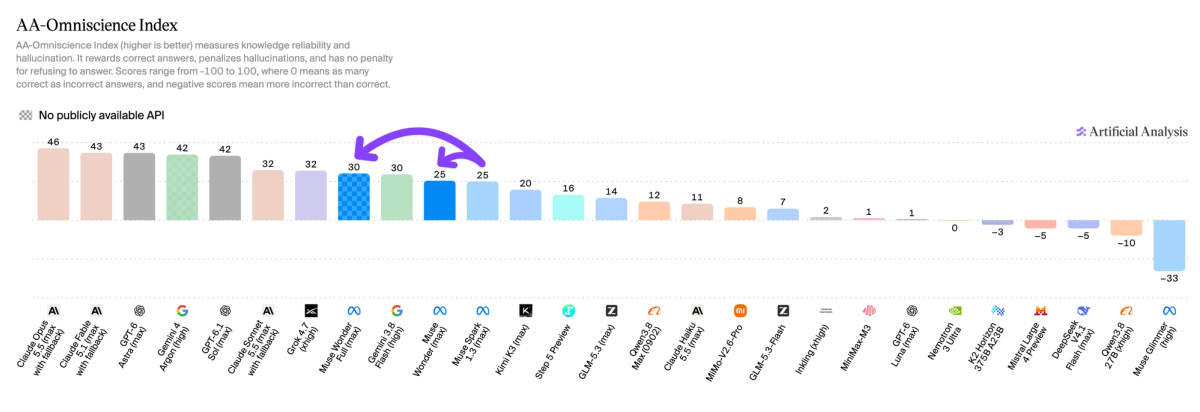
Artificial Analysis. Full is 30. The API model and Spark 1.3 are 25. Opus, Astra, and Argon sit above them.
Coding agents, by harness
On the Coding Agents Index, Full at max in Muse Code scores 68. Sonnet 5.5 at max in Claude Code is also 68. Opus 5.5 at max in Claude Code is 66. The API model at max scores 63. Spark 1.3 at max in Muse Code was 54. A 68 in Muse Code and a 68 in Claude Code are the same number on two harnesses. Read them as a tie on the chart Artificial Analysis draws.
Meta's names for the product behavior are Active Memory and Active Focus: carry context across conversations, keep working when the task blocks, ask before a consequential action. The independent numbers that moved are the agentic ones above. Meta's own MemoryBench and FocusBench are internal, and they are not the index.
In practice
- Subscribe to Muse Code if you want the stronger model. That is Muse Wonder Full, on the $50 and $200 plans. It has no per-token price, so the $4.52 does not apply to it.
- Call muse-wonder-1.0 when you need the API. That score is 52. The 56 stays inside the subscription.
- The six-week jump showed up on agents. Terminal-Bench went from 33% to 52% on the API model and to 57% on Full. Full's GDPval move is 1681 to 1857 Elo, inside the band of Opus and Sonnet on this run. Briefcase went from 1581 to 1729.
- For a callable model at index 52, GPT-6.1 Sol's max is the same score at $0.72 a task. Astra's max is 53 at $3.26. The API model's max is $4.52, and three-quarters of that is input and cache.
- On coding agents, Full's 68 is Muse Code and Sonnet's 68 is Claude Code. The API model is 63. Spark in Muse Code was 54.
- Expect a weaker knowledge score than the index suggests. Omniscience is 30 for Full and 25 for the API model, with hallucination at 23% and 27%.
- Keep Meta's launch table in its own column. Those cells are max effort, except the Full SWE-Marathon figure, which is xhigh. When a Meta cell and an Artificial Analysis cell share a name and disagree, they are two measurements.
Sources: Muse Wonder, the model card, Meta's model page, Artificial Analysis, and OpenRouter. The index of 56 and 52, Terminal-Bench, GDPval, Briefcase, the token counts, and the $4.52 task are Artificial Analysis, at max effort. The API id, the $4 / $0.20 / $20 price, and the Muse Code plans are Meta's.